
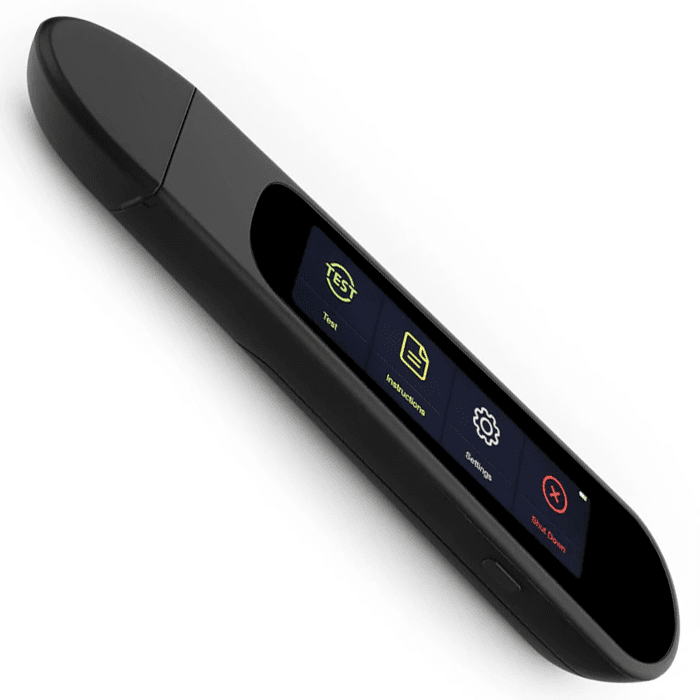
Arete Natural and Lab Grown Diamond Tester Gemtrue by Betts Metals
Details
The Gemtrue ARETE Natural and Lab Grown Synthetic diamond tester from Betts Metals is an essential tool for the experienced jeweller and professional diamond dealer. There is a huge difference in price between 'natural' and 'synthetic' diamonds ; you need to know what you are buying, and you need to tell your customers what you are selling.
Providing you are quite certain you have a diamond, test it on the Arete synthetic diamond tester (Gemtrue) from Betts Metals to see the chances of it being natural or synthetic. "Natural" means dug from the ground (mined). "Synthetic" is identical but grown in a laboratory (lab-grown, lab-created, manmade).
The Gemtrue ARETE synthetic diamond tester from Betts Metals will distinguish synthetic diamonds from natural diamonds. It will also detect Moissanite.
The Arete synthetic diamond tester (Gemtrue) is not a diamond tester for distinguishing diamond from non-diamond; we sell these tools as well, and the item codes is TOOLSQTDET
What does a diamond tester test for?
Natural diamonds grow as crystals deep in the Earth; they are brought nearer the surface through volcanic activities where they are mined (they are also known as mined diamonds). It takes 2 to 3 billion years for a diamond crystal to grow naturally.
Synthetic diamonds are grown by man in a laboratory over a period of a few weeks. "Synthetic" is the scientific term. Colloquially, we say lab-grown or manmade or lab-created. It takes a few weeks to grow a synthetic diamond in a laboratory.
Synthetics and naturals are identical; they are both diamonds. They are the same chemically, and they are the same optically. That is why it is so difficult to tell them apart. If you just want to know if you have a diamond or not a diamond, then you just need item ref TOOLSQTDET
How does diamond testing work? METHOD
1. Test the stone on a standard diamond tester to see if it is not diamond, or if it is diamond or Moissanite (it could be either). If you have a 'multi' diamond tester, it will also test for Moissanite.
2. Once you are certain you have a diamond, test it on the Arete synthetic diamond tester (Gemtrue) from Betts Metals to see if it's Moissanite, natural diamond, or synthetic diamond.
GUARANTEE
The Gemtrue ARETE synthetic diamond tester from Betts Metals is guaranteed for 1 year.
Gemtrue ARETE diamond tester features:
- Handheld and lightweight
- The Gemtrue ARETE synthetic diamond tester from Betts Metals can test any stone mounted in jewellery or loose.
- Also tests for Moissanite.
- Fastest response time (test result in 2 seconds).
- Although there's an instruction leaflet, there are also videos of the instructions on the actual display on the tester.
- Results are displayed on the screen and, at the same time, confirmed by voice.
Whats included:
- The tester
- Neat heavy-duty carrying pouch for the pocket and a larger case for storage
- Stone-holder for loose stones (you can also test stones mounted in jewellery
- Polishing cloth (to clean the stone before the test)
- Alcohol wipes (for cleaning the test-tip)
- Diamond gauge (to check that the stone is at least 0.02ct in size)
1. Clean the top (table) of the stone with the polishing cloth.
2. Do not remove the cap. Turn it on, wait 5 seconds for it to warm up.
3. Place the probe in the centre of the stone as instructed on the display and see the reading (details below).
What does a diamond tester tell you? THE READINGS:
- CVD / HPHT / Type IIa diamond: CVD/ HPHT are two methods of growing diamonds = synthetic. Type IIa diamond is a very rare type of natural diamond that will show up as 'synthetic' on this tester. So, if the tester shows,
- CVD / HPHT / Type IIa Diamond" there is a good chance it's synthetic, but this is not guaranteed.
- DIAMOND: By "diamond" they mean natural diamond.
- MOISSANITE: Moissanite is not diamond (neither natural diamond nor synthetic diamond), but it is useful to be able to detect these because they show up as diamond on cheap diamond testers.
You notice that there isn't a reading for not diamond ("simulant"); if you are not a diamond dealer or experienced jeweller, you must be certain you are testing a stone that will register 'diamond' on most diamond testers; testing non-diamonds on a synthetic diamond tester can give incorrect readings.
Size: 192mm X 42mm X 21mm
Weight: 76g
Tests: stones from 0.01 to 3 carats incl. mounted stones in any setting
Tests: stones of colour D to J
Tests: round (brilliant cut) stones that are perfectly polished
It is important to understand what these limitations mean; see our guide to synthetic-diamond testing.
RESPONSE TIME
- Start-up time 5 seconds
- Testing time 2 seconds
POWER
- Power: four AAA batteries (supplied)
- Battery life: 4 hours of testing
- Auto-power-off: yes, if used on battery power it turns itself off after 10 minutes of non-activity.
ACCURACY
We don't have official figures, but typically, these give a correct result about 95% of the time, providing the colour is 'clear' (colour D to J) and the size is at least 0.02ct and the cut round ('brilliant') and perfectly cut.
How can you tell if a diamond is real at home? GUARANTEE
A synthetic-diamond tester is for the experienced jeweller and professional diamond dealer. It is not for testing diamond v. non-diamond. 5% of natural diamonds have an unusual composition ("Type IIa diamond") and cannot be distinguished from synthetic diamonds. Stones must be at least 0.8mm in diameter (approx. 0.01ct), so if the stone is small, check it with a diamond gauge.
Stones must be Brilliant Cut (modern, round) and perfectly cut in proportion; it will not test shallow stones. For the non-expert: make sure the stone is recent (e.g., not from the 19th century) and is round. For the professional jeweller: if you specialise in Victorian jewellery (or earlier), this tester might not be suitable; it will not give accurate results on rose-cut etc.
The stone must be very 'white' in colour (colour D to J). For the non-expert: if it has any colour (e.g., the tiniest slightest yellow tint), you won't get an accurate reading. It takes an expert to colour-grade a stone; to the non-expert, Colour Grade D will look the same as Colour Grade J. For the professional jeweller: if you work at a shop counter and don't understand this, please ask your diamond expert to colour-grade the stone for you. Alternatively, buy a set of colour-graded stones and match your stone against one of the samples in the set.
Disclaimer
All testers must be used in conjunction with the user's skill, knowledge, and experience. Under no circumstances shall Betts Metals be liable for direct or indirect loss sustained in connection with any item. Nothing is 100% accurate; you must understand the limitations of any tester you buy. We also suggest you regularly test known samples to check for any obvious faults.
More Info
| Weight | 0.076000 kg |
|---|---|
| Image info | Product images are for illustrative purposes only and may differ from the actual product |
| Tool type | Workshop equipment |
| MPN | ARETE |